
Can Airbus, Thales and Leonardo Merge Their Way to Scale?
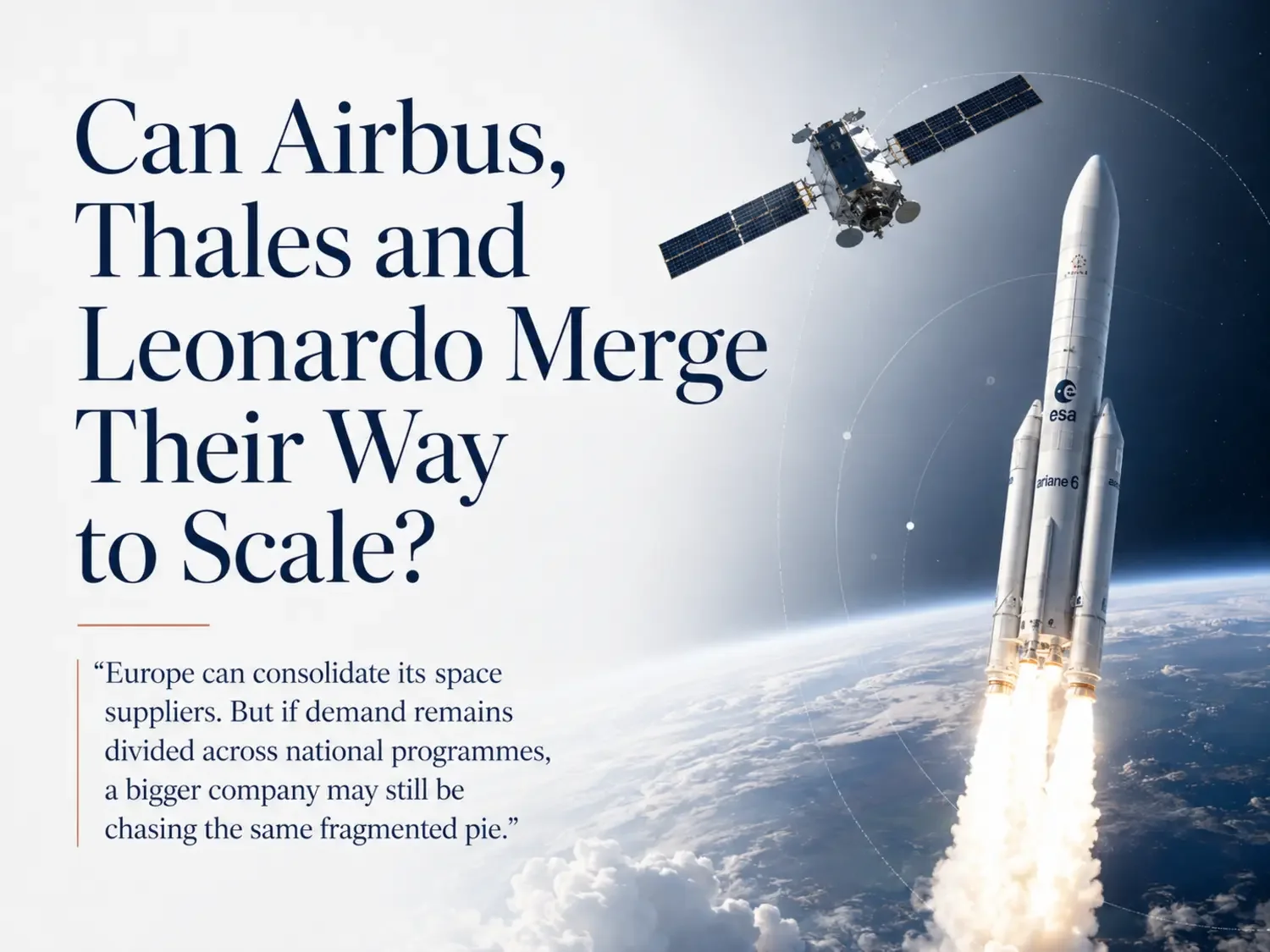
For firms treated as critical infrastructure, what type of corporate structure makes sense, and what kind of government support actually helps companies reach scale?
When firms want to compete more effectively on the international stage, a merger is one option. It can pool complementary technologies, engineering teams, customers and capital into a larger organization. On the other side of the coin, governments trying to build stronger industries or “champions” have their own toolkit — subsidies, procurement, infrastructure investment and sometimes political support for consolidation.
Airbus, Thales and Leonardo plan to combine much of their satellite and space-services businesses into a new company with around 25,000 employees and €6.5 billion in annual revenues. The rationale for this type of move is familiar: spread research costs across a larger business, remove duplication, improve manufacturing efficiency and build enough scale to compete with SpaceX and formidable Chinese rivals.
That sounds plausible. To capture scale through a merger, a lot depends on how specialized the industry is, how easily companies can work across corporate boundaries and where the real economies of scale are located.
1. What actually improves when there is common ownership?
Merging companies looking for scale usually expect a larger organization to compete more effectively through greater bargaining power, broader customer reach, shared technology and larger pools of R&D.
Project Bromo would combine largely overlapping satellite manufacturing, space systems and services. Airbus, Thales and Leonardo expect substantial savings from common R&D, engineering, manufacturing and project management.
But mergers are expensive and difficult to unwind. Companies usually have other options: joint ventures, partnerships, consortiums or long-term supplier arrangements. The industry itself is made up of different structures. Airbus was a consolidation of several national aerospace firms. Thales Alenia Space is a JV between Thales and Leonardo.
SpaceX is rather different. Its vertical integration means it owns several powerful links in the chain. It builds Starlink satellites at enormous scale, builds the rockets that carry them, operates launch facilities and sells the service produced by the constellation. Starlink creates demand for launches; launch frequency creates experience and helps spread fixed costs; lower costs make further constellation expansion easier. The different parts of the company reinforce each other.
Project Bromo stops well short of that degree of vertical integration. Important to note, heavy launch vehicle operations are explicitly excluded. The combined company would therefore still need to buy rides from launch providers such as Ariane 6 — whose prime contractor ArianeGroup is jointly owned by Airbus and Safran — or, where necessary, SpaceX.
2. Is company size really the problem — or is the customer base?
Europe may have smaller space businesses than SpaceX. It also has a very different home market. Some, notably Airbus’ CEO Guillaume Faury, argue that consolidation of demand is also required.
The reality of SpaceX’ success shows that it did not grow solely because it integrated vertically . It always had an anchor customer - the US government. NASA’s 2008 contract for cargo missions to the International Space Station was worth $1.6 billion, followed by billions more for crew transportation and other missions.
Europe is starting to use the same lever. IRIS², the EU’s secure satellite network, is creating large, long-duration orders for European companies. OHB has recently secured a contract worth close to €1 billion to build 18 satellites for the network.
Elsewhere, however, European demand remains divided among national programmes. France, Germany, Italy and Spain have their respective security priorities, procurement systems and domestic industrial interests. There are understandable sovereignty reasons for this, but commercially it divides the home market into smaller pieces.
If Airbus, Thales and Leonardo combine while national governments continue buying largely through separate programmes, Europe could end up with a much larger supplier still chasing a relatively fragmented pie.
So before concluding that the company itself needs to become bigger, management needs to ask whether the more important problem sits outside the company: is there actually a market large and predictable enough to support the scale being created?
3. How do you bring the wider ecosystem with you?
A merger aimed at global scale does not have to come at the expense of smaller companies around it. In fact, one of the strongest arguments for creating a larger European space company would be that greater international reach creates more opportunities for the European suppliers that support it.
Airbus, Thales and Leonardo are not the entire European space industry. They depend on launch businesses, specialist engineering firms, component manufacturers, software companies and smaller satellite makers. A combined company that wins more global programmes, spends more on R&D and places larger orders could pull those businesses up with it.
That ecosystem effect should therefore form part of the merger strategy from the beginning.
Companies can decide which activities need to be done by the merged company itself, and which ones could be bought from suppliers. They can think about supplier access, procurement arrangements and interfaces with smaller businesses. That helps pre-empt regulatory problems. They can also show how greater scale at the top translates into more investment and market access further down the chain.
Others in the industry will raise concerns about potential disadvantages to competition. OHB has warned that Project Bromo could reduce competition and affect its access to suppliers, and has raised the possibility of legal action if the transaction is approved.
Europe is trying to reconcile two competing objectives: building globally competitive companies in service of its industrial goals, while trying to preserve healthy rivalry inside the 27-member European market. That balancing act is harder in the EU than in a single-country system, because national governments still have their own strategic interests.
Tata Steel and ThyssenKrupp proposed combining their European flat-steel businesses at a time of severe competitive pressure. The companies argued that greater scale would create a more sustainable European steel business. Brussels nevertheless blocked the joint venture in 2019 because it concluded that European customers would face reduced competition and higher prices.
Siemens and Alstom encountered the same objection in rail. Their proposed combination was argued as a way to create greater European scale against international rivals, particularly China’s CRRC.
Neither case, however, involved the same critical infrastructure and national security arguments now surrounding European space. Governments may want stronger European companies because they want less dependence on American or Chinese suppliers for defense purposes. Yet the same governments may be uncomfortable becoming dependent on one European supplier for a critical service. In critical infrastructure, having credible alternatives is an essential part of resilience.
Therefore, to better argue the case for scale, it goes beyond saying that a bigger company can compete with SpaceX. It should show how the merger can create a stronger company and a stronger ecosystem around it.
