
POLARBRIEFAnalysis on
what matters.
At the intersection of geopolitics, law, and business strategy — translating what is shifting in the world into what it means for the decisions organizations face.
Alibaba’s European Expansion: Can China’s AI Stack Overcome Regulatory Hurdles to Become Europe’s Third Option? Part I: Data, Foreign Access, and the Limits of Localization
Alibaba’s Qwen models, cloud platform and proprietary AI chips aim to offer European companies a lower-cost, capable alternative to US giants and European providers across the AI stack. But its success will rest heavily on how it adapts to Europe’s regulatory fences.
When is a Data Center Deal No Longer a Good Deal?
From the outside, massive data center projects hold great promise for both developers and regions they build across the globe. However, the initial rush has narrowed into an obstacle course of power queues, political backlash, and export controls. Governments initially wanted the same things from these projects — huge investment and jobs, tax revenue, and the good news of AI sovereignty. But the environment has shifted in recent times to reflect geopolitical tensions and resource anxiety.
What NVIDIA Gains From Keeping AI Open
NVIDIA is buying far more than an AI developer platform. It can expect massive gains from keeping Hugging Face open, more than from locking developers into CUDA or handcuffing them to NVIDIA chips. It is combining power on three spheres: compute, the gateway and information. The last sphere is becoming more geostrategic, as government scrutiny moves beyond chips to how models are accessed and used.
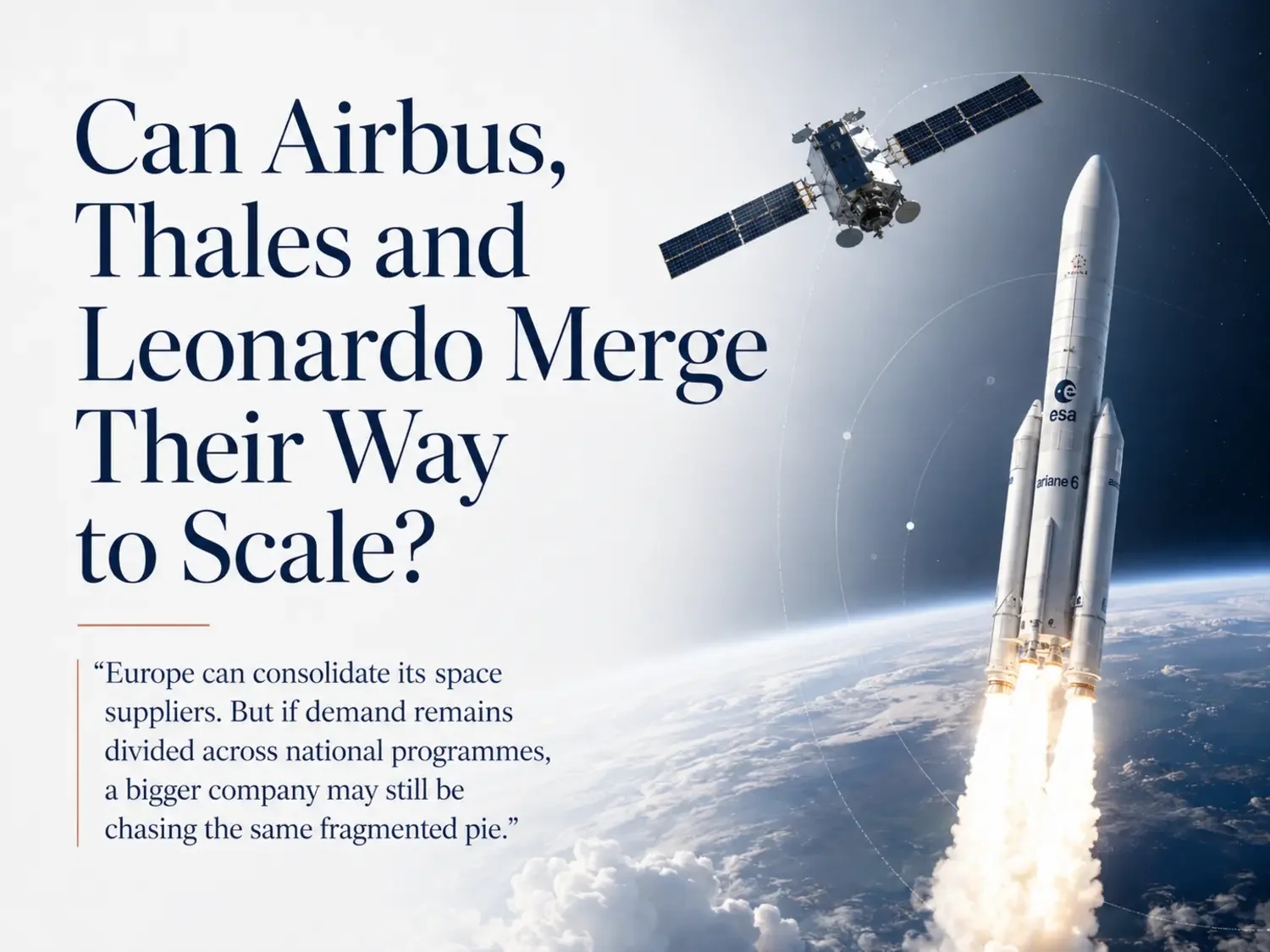
Can Airbus, Thales and Leonardo Merge Their Way to Scale?
When firms want to compete more effectively on the international stage, a merger is one option. It can pool complementary technologies, engineering teams, customers and capital into a larger organization. On the other side of the coin, governments trying to build stronger industries or “champions” have their own toolkit — subsidies, procurement, infrastructure investment and sometimes political support for consolidation.
Airbus, Thales and Leonardo plan to combine much of their satellite and space-services businesses into a new company with around 25,000 employees and €6.5 billion in annual revenues. The rationale for this type of move is familiar: spread research costs across a larger business, remove duplication, improve manufacturing efficiency and build enough scale to compete with SpaceX and formidable Chinese rivals.

How Chip Tracking Changes the Neocloud Business
Neoclouds and data center operators are being thrusted into new gatekeeper roles. The AI stack worldwide relies heavily on NVIDIA chips and with that comes stringent export controls. While virtually all players are impacted by NVIDIA chip telemetry (remote tracking) and new export control expectations, business risk and operational burden fall most significantly on those two layers.
Canada Walked Away. Now Businesses Must Move.
Walking away from the table carries a price tag of 50% tariffs now. Walking away also strips away the assumption that a strong Canadian economy must always depend on neighboring trade. Much weaker countries have transformed themselves in the face of far harsher conditions. Resource-rich countries have also used their natural advantages to springboard sophisticated domestic industries, becoming trusted global partners in their own right.
All signs pointed to negotiations that were zero-sum. Carney is right to sprint away from any quick, shiny announcement of a “deal” that could have served as a Trojan horse.
Tariff Discussions Do Not Resolve Commercial Risk
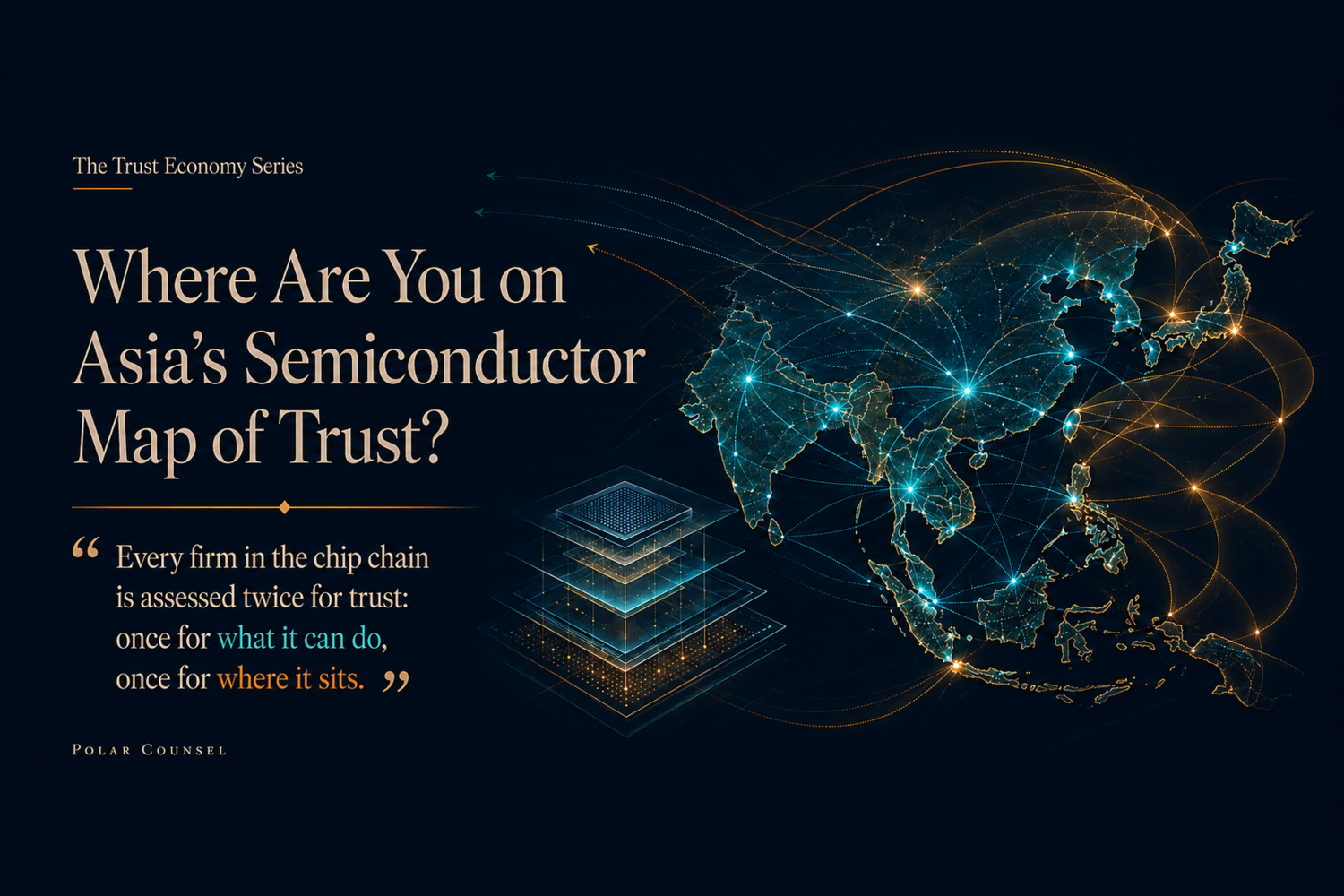
Where Are You on Asia’s Semiconductor Map of Trust?
Asia’s chip ambitions are gathering force and countries are pursuing overlapping strategies but gradually diverging alignments. Some are trying to climb into more strategic parts of the stack. Others, such as Japan, are already embedded in critical layers of the chain. The question all are grappling with centers around trust: who will be trusted to handle more sensitive work or become irreplaceable in the global contest?
For countries trying to move up the stack, the race is deeper than selling. It is to get inside the customer’s product, process or roadmap — to become so embedded that removing the role essentially requires product redesign or requalifying the supplier.
Asian Players Buying Chips and AI: Who Gets Past the Bouncers?
Buying advanced AI chips is no longer simply a contest of price, technical need and delivery schedules. Suppliers increasingly want to know who owns the buyer, who will actually use the equipment, where the computing power will be deployed and whether a Chinese-controlled entity sits somewhere behind the transaction.
Recent US guidance has clarified that restrictions covering sensitive American technology may apply not only to named Chinese companies, but also to entities they ultimately own. Nvidia has reportedly responded by sharply reducing the number of approved Asian customers across Singapore, Malaysia and Japan after intensive checks on ownership and end users. Access to its most sought-after processors increasingly depends on making it onto a heavily vetted “white list.”
In this case, neo-cloud operators were the most affected. But these matter equally to Asian data-centre operators, semiconductor manufacturers, telecom groups building AI infrastructure, industrial companies developing proprietary AI, sovereign-backed technology platforms and regional businesses whose investors, customers or affiliates span China and the West.

Why Polestar Changes the Rules of Market Access
Polestar is headquartered in Sweden, listed on Nasdaq, and manufactures vehicles in South Carolina. Yet when it came to maintaining access to the US market, those markers of global integration mattered less than the ownership structure behind it. Following a decision under new US connected vehicle restrictions, Polestar will no longer be permitted to sell future vehicle models in the American market. The decisive factor was not product, compliance, or operations, but its Chinese ownership structure.
For multinational companies operating across increasingly fragmented geopolitical markets, that should command attention. Polestar is not an isolated story. It is the latest expression of a regulatory logic that has been gaining momentum for years -one increasingly focused not simply on what companies do, but who ultimately controls them. To understand how this logic developed, it helps to look at the pattern that came before.
Soil Strategy and the Politics of Capital in Frontier Technology
Written with Anita Ng (Kompass Advisory)
Founders building frontier technology companies spend enormous time on product, talent, speed, valuation, and dilution -far less on the structure forming around the company during its earliest financing rounds, even though those decisions often shape far more than ownership. Financing is often secured before the strategic value of those technologies is fully understood. By the time governments, investors, or acquirers pay close attention, the legal and commercial relationships surrounding the company are already deeply embedded.
Competition over frontier technology no longer begins at scale - it begins at the level of ecosystem design itself. Countries are increasingly competing not simply to attract startups, but to shape the capital, infrastructure, and institutions through which strategically important companies are built. Because capital in strategically sensitive sectors is increasingly not a neutral commodity, that choice is a strategic decision about where ...
Asia’s Next Economic Play: Supply Chains, Semiconductor Scale, and Economic Integration in a Multipolar World
Geopolitical rivalry is reshaping the rules of trade - and Asia's leaders are saying so directly. At the Future of Asia forum in Tokyo, Malaysian Prime Minister Anwar Ibrahim warned that export restrictions and industrial policies are increasingly being driven by strategic competition rather than economic logic, risking a division of the region into competing spheres that would force countries such as Malaysia to choose sides. His comments underscore the challenge facing many economies across Asia. Their prosperity has been built on openness, trade, investment, technology partnerships, and access to multiple markets. As geopolitical competition intensifies, many governments are seeking to preserve those relationships rather than narrow them.
Malaysia's response has been pragmatic. Alongside discussions on artificial intelligence, critical minerals, maritime cooperation, and energy security, it continues to position itself as a trusted manufacturing, logistics, and investment destination. Newly signed agreements with Japan on energy ...
The Trade Fog Thickens: Hormuz, Tariffs, and the Fragility of Diversification
The disruption around the Strait of Hormuz and freshly announced US plans to levy additional duties on 60 economies are often discussed separately - one as a geopolitical and energy issue, the other as a trade war. In practice, both operate as geoeconomic pressures that compound each other. The challenge for companies is increasingly cumulative rather than isolated. Contingency plans are facing frequent twists. Assumptions embedded in existing supply-chain models are becoming unstable at the same time.
The Hormuz crisis squeezes shipping access, freight pricing, insurance costs, rerouting pressure, delivery reliability, and energy flows. This also causes heavy timing pressure from supply-chain rerouting, inventory repositioning, and logistics disruption. Companies accelerating shipments ahead of tariff deadlines are now competing for the same constrained carrier capacity that the Hormuz disruption has already tightened. Therefore, an additional layer of tariffs or even just uncertainty risks triggering another surge ...
Jakarta’s Nickel Play: State Control and the Future of Strategic Supply Chains
Indonesia's latest move to centralize commodity exports through a state entity represents a significant shift in how strategic resources are governed. Unlike simple export restrictions or resource nationalism, Jakarta is restructuring the entire commercial architecture of the nickel market - replacing direct producer-to-buyer negotiation with centralized state control. At the centre of the proposed framework is Danantara Sumberdaya Indonesia (DSI), a trading company under Indonesia's sovereign wealth fund structure that will become the sole export channel through which producers of nickel, coal, palm oil, and other strategic resources sell to overseas buyers.
This is expected to fundamentally alter the commercial structure of Indonesia's commodity markets by replacing decentralized producer-to-buyer trade with a centralized state-run export system. For contracts already in place, the state will "evaluate" those that represent under-invoicing. Through overhauling governance and directly managing trades with foreign buyers, Indonesia is positioning itself to attract ...

The Tariff Fog is the New Operating Environment – How Businesses Must Respond Strategically
The global trade system is not accidentally broken. It is being remade- by governments with incompatible visions of what it should become. What looks from the outside like chaos - tariffs on, tariffs off, court rulings, bilateral summits, retaliation regulations - are signs of geopolitical restructuring. The question for multinational executives is not whether stability will return. It is how to make consequential decisions before it does.
Three developments define the current moment: the judicial unravelling of US tariff orders; the Trump-Xi summit and the emergence of managed bilateralism as the preferred architecture of global trade; and China's counter-regulatory response, which is quietly making supply chain reconfiguration far more costly than most boardrooms have modelled. Businesses face pressure from both directions simultaneously - Washington pulling supply chains out of China, and Beijing making it costly to go. Every exit has a price. What the Courts ...

AI Stack Fragmentation: Critical Decisions Under Geopolitical and Regulatory Divergence
A three-way contest over the future of AI infrastructure is reshaping the conditions of global business. The way companies navigate overlapping regulatory and geopolitical frameworks will determine whether large-scale capital investments translate into sustained value creation or structural constraint.
Brussels, Beijing, and Washington are each developing distinct legal frameworks - AI laws, data regulations, export controls, national security powers, and investment screening mechanisms - that collectively govern the technology stack defining the next decade of economic activity. These instruments reflect individual policy priorities, and in several important respects produce incompatible obligations for businesses operating across all three jurisdictions. For firms deploying AI across borders, the result is not limited to incremental compliance complexity, but structural divergence in operating conditions. Decisions on architecture, vendor ecosystems, data geography, and market access increasingly sit at the intersection of capital allocation and