
Jakarta’s Nickel Play: State Control and the Future of Strategic Supply Chains
Indonesia’s latest move to centralize commodity exports through a state entity represents a significant shift in how strategic resources are governed. Unlike simple export restrictions or resource nationalism, Jakarta is restructuring the entire commercial architecture of the nickel market — replacing direct producer-to-buyer negotiation with centralized state control.
At the centre of the proposed framework is Danantara Sumberdaya Indonesia (DSI), a trading company under Indonesia’s sovereign wealth fund structure that will become the sole export channel through which producers of nickel, coal, palm oil and other strategic resources sell to overseas buyers. This is expected to fundamentally alter the commercial structure of Indonesia’s commodity markets by replacing decentralized producer-to-buyer trade with a centralized state-run export system. For contracts already in place, the state will “evaluate” those that represent under-invoicing.
Through overhauling governance and directly managing trades with foreign buyers, Indonesia is positioning itself to attract investment from multiple sources while maintaining greater sovereign control over how strategic resources are priced and allocated.
Background. Nickel sits at the centre of the global EV supply chain and remains deeply embedded in battery manufacturing, industrial policy and strategic competition between China and the US. Indonesia now accounts for more than 60 per cent of global refined nickel supply, a position built through more than a decade of increasingly interventionist industrial policy.
Beginning with the 2014 ban on raw nickel ore exports, followed by additional restrictions in 2020 and 2022, Jakarta successfully forced refining capacity onshore, attracted massive Chinese investment and rewrote the economics of global nickel processing. Export revenues reportedly surged from roughly US$3 billion in 2020 to around US$40 billion in 2024, while industrial parks, smelters and downstream battery projects expanded rapidly across the country.
Indonesia’s export restrictions have drawn WTO scrutiny, yet by most measures, the strategy of onshoring refining capacity has worked. Indonesia transformed itself from a commodity exporter into the dominant force in global nickel refining and downstream processing.
Jakarta is taking a further step and assessing how much leverage that dominance gives the state over the broader ecosystem surrounding the commodity.
This is not Venezuela-style nationalisation, nor does Indonesia appear interested in excluding foreign capital. The country still wants multinational participation, downstream investment and continued integration into global EV supply chains. But the direction of travel suggests a state that no longer wants to remain merely a passive owner of strategic resources. Instead, Jakarta wants to determine how those resources are exported, priced, and allocated, potentially leveraging resource dominance to exert greater influence over strategic pricing and allocation.
The Issue. Shares in Indonesian commodity producers fell following reports surrounding the proposed framework, amidst fears of a potential monopsony reducing openness and competitiveness in the industry.
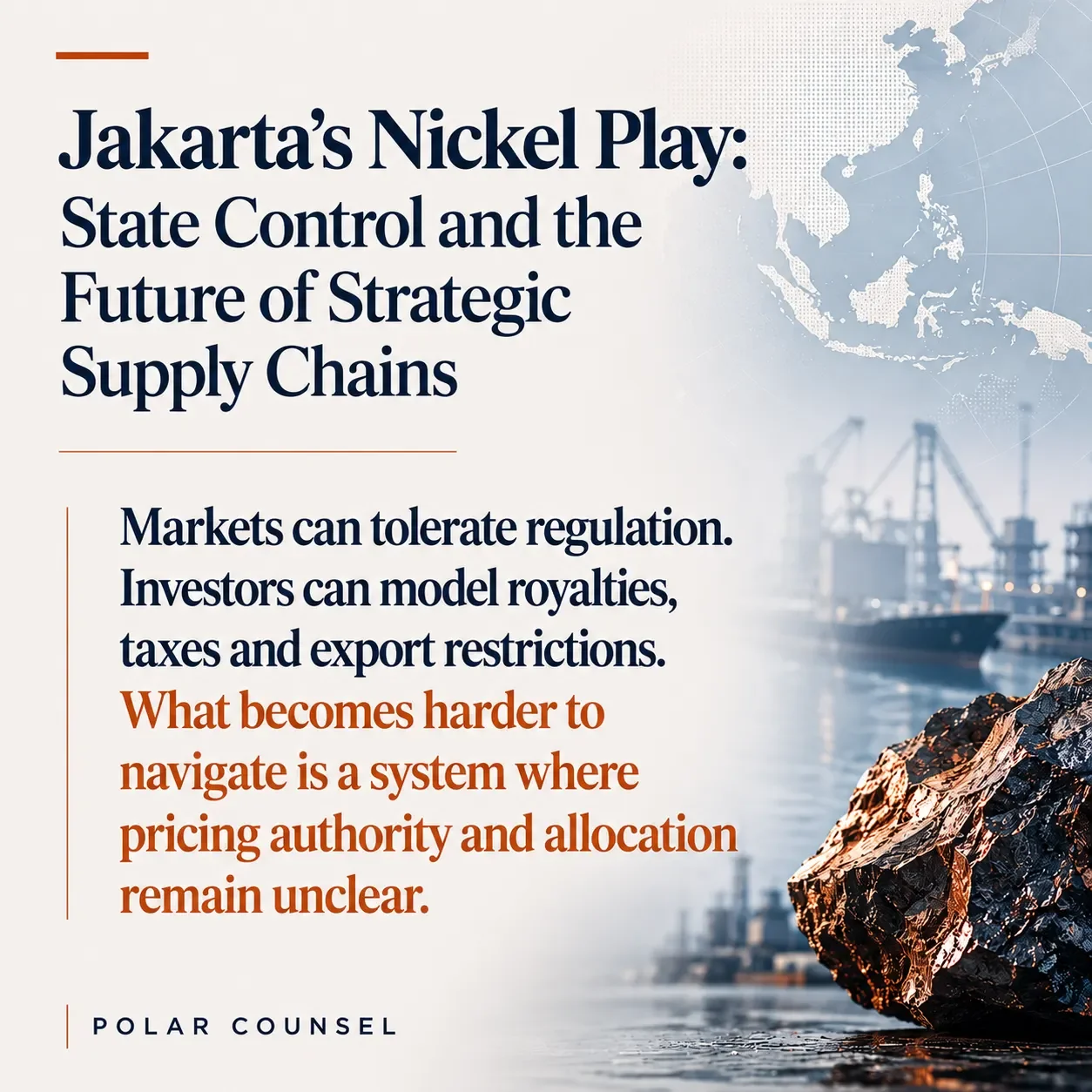
The challenge for companies and investors is not greater regulation itself so much as it is unpredictability. Markets can tolerate regulation. Investors can model royalties, taxes and even export restrictions. What becomes more difficult to model is a system where pricing authority, export approvals and allocation mechanisms become increasingly centralized while the eventual rules governing that centralization remain unclear.
That vulnerability is particularly acute in nickel because the sector depends on enormous amounts of long-duration capital. Smelters, HPAL projects and downstream battery facilities require financing assumptions that extend years into the future and are typically underwritten on the basis that exports remain workable, profits remain transferable and the operating environment remains sufficiently understandable.
Once assumptions around predictable exports, commercially grounded pricing and long-term regulatory stability start to weaken, markets inevitably start repricing assets accordingly.
The proposed Danantara structure that kicks off on June 1 also changes the commercial dynamics of the nickel market itself. Before, producers negotiated directly with overseas customers on pricing, contract structures and supply allocation. Under the proposed framework, those relationships increasingly move through the centralized state intermediary. Producers lose direct export discretion, while overseas buyers lose access to multiple competing sellers. Pricing becomes less purely market-driven and more subject to state coordination, while allocation itself increasingly becomes a strategic function rather than a purely commercial one.
Managing Multiple Investors. Indonesia’s evolving export structure aligns with Washington’s push to build critical-mineral supply chains meeting specific governance and transparency standards. That dynamic became more significant in March, when the United States and Indonesia signed a trade agreement designed to facilitate greater US participation across Indonesia’s critical-minerals sector. For Jakarta, the timing reflects a deliberate effort to diversify investment sources and ensure that commodity governance attracts capital from multiple origins rather than concentrating dependency on any single investor base.
The agreement committed Indonesia to allowing and facilitating US investment across the nickel value chain on terms “no less favorable” than those accorded to domestic investors. It also imposed expectations around how Indonesian state-owned or state-controlled enterprises should operate commercially, including commitments to avoid discriminatory treatment and maintain commercially grounded decision-making.
That deal provides important context to Indonesia’s proposed export-centralization framework that emerged only three months later.
At first glance, the two developments may appear contradictory. One points toward greater state coordination, while the other seeks to reassure US capital. In practice, however, Jakarta is looking to drive both objectives simultaneously: exerting greater sovereign influence over strategic resources while still positioning Indonesia as a credible destination for Western investment seeking alternatives to embedded supply chains.
This framework is designed to accommodate both Chinese capital already embedded in Indonesian refining and new Western investors seeking rules-based systems—but the two may ultimately operate under different assumptions about predictability and state discretion.
A more centralized export structure could, if executed correctly, make Indonesian nickel easier for US-linked investors and industrial buyers to navigate if it produces clearer pricing benchmarks, standardized export procedures and more traceable supply chains. For Washington, the issue is not simply access to nickel itself, but access through systems capable of satisfying requirements around ownership visibility, sanctions compliance, ESG standards and Inflation Reduction Act eligibility (tax incentives for materials sourced from allied-nation supply chains).
State coordination itself does not necessarily deter investment or undermine operational success. What matters is whether investors can understand and rely on the rules governing those systems. Norway has demonstrated this — attracting substantial foreign capital into strategically important energy sectors despite strong state involvement, because the regulatory framework remains transparent and consistent.
The difference between success and failure hinges entirely on implementation. Transparent pricing benchmarks and standardized procedures could attract Western capital seeking trusted supply chains. Discretionary allocation and opaque pricing authority would likely trigger the opposite—capital diversification and supply chain redundancy.
Conclusion. For more than a decade, Jakarta successfully used industrial policy to pull refining capacity onshore, attract investment and establish itself at the centre of the global nickel market. The proposed Danantara framework represents the next stage of that evolution: an attempt not only to shape production, but to exert greater influence over how strategic commodities themselves are traded, priced and allocated.
Whether that ultimately strengthens Indonesia’s position or weakens investor confidence will depend less on the existence of state coordination itself than on how that coordination is implemented.
Takeaway
Indonesia is entering a new phase of commodity governance in which the state seeks greater influence over how nickel is exported, priced and strategically deployed. The significance of this shift extends beyond Indonesia itself because nickel now sits at the intersection of EV supply chains, industrial policy and geopolitical competition between China and the United States.
The more immediate question for industrial participants is how a more centralized export system changes the mechanics of operating in Indonesia’s nickel ecosystem — including who negotiates access, how pricing is determined and how future supply relationships are structured.
