
The Tariff Fog is the New Operating Environment – How Businesses Must Respond Strategically
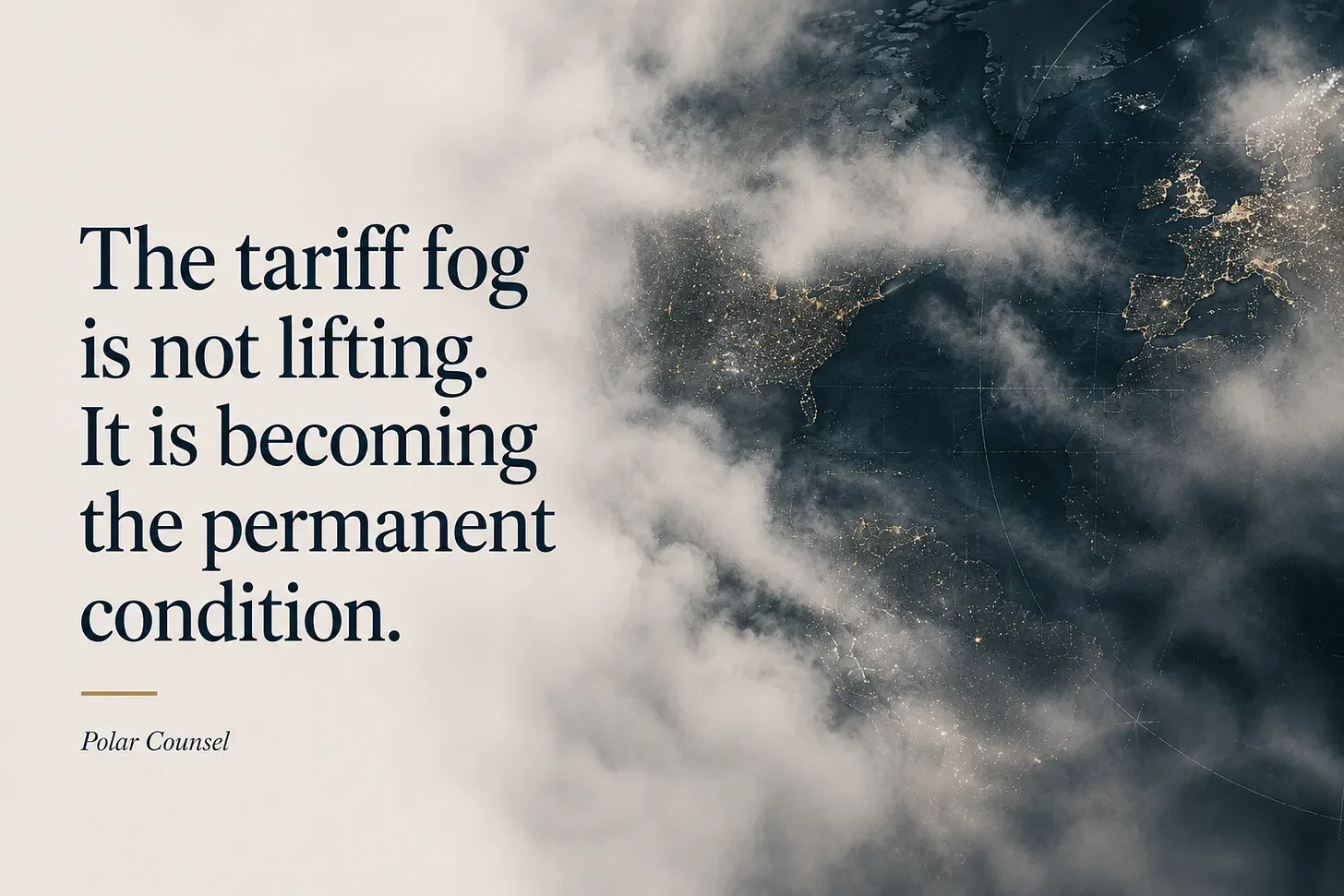
The global trade system is not accidentally broken. It is being remade – by governments with incompatible visions of what it should become. What looks from the outside like chaos — tariffs on, tariffs off, court rulings, bilateral summits, retaliation regulations — are signs of geopolitical restructuring. The question for multinational executives is not whether stability will return. It is how to make consequential decisions before it does.
Three developments define the current moment: the judicial unravelling of US tariff orders; the Trump-Xi summit and the emergence of managed bilateralism as the preferred architecture of global trade; and China’s counter-regulatory response, which is quietly making supply chain reconfiguration far more costly than most boardrooms have modelled. Businesses face pressure from both directions simultaneously — Washington pulling supply chains out of China, Beijing making it costly to go. Every exit has a price.
What the Courts Have — and Have Not — Done In Three Separate Tariff Actions
Two rulings in 2026 have materially altered the US tariff landscape.
In February, the first tariff measure was struck down by the Supreme Court. It found that tariffs imposed under the International Emergency Economic Powers Act (IEEPA), were intended for emergency controls over financial transactions — not the imposition of customs duties. In May, the second tariff measure was struck down by the US Court of International Trade. It ruled that the 10% baseline tariff imposed under Section 122 of the Trade Act of 1974 unlawful — it was designed for narrow, temporary balance-of-payments surcharges, not broad trade policy.
The third tariff measure sits on much firmer legal authority. These are the investigations targeting unfair trade practices by China under Section 301 powers. The US continues to pursue these, and China has countered with its own investigations in US practices.
The practical result is a patchwork. Some tariffs are unlawful and refundable in principle; others are legally secure. The right to refunds is real, but not automatic — they require individual protest filings with US Customs and Border Protection within strict deadlines. The May court order granted relief only to the named plaintiffs, so there is no automatic nationwide refund. Every importer faces its own determination. And, the government has appealed the May decision.
Uncertainty increases. For most firms, the refund question — while financially material — is not the primary operational concern. Many are pricing tariffs in, adjusting cost structures, renegotiating supplier terms, and absorbing or passing on the additional burden. The deeper problem is uncertainty: not knowing which tariffs currently apply, whether they will change, and what new measures may emerge in their place. That uncertainty carries its own cost — in delayed capital decisions, over-engineered contingency planning, and executive attention consumed by legal monitoring rather than commercial execution.
There is also a political dimension acknowledged by companies. When the Supreme Court struck down the IEEPA tariffs, President Trump encouraged companies not to seek refunds, stating: “If they don’t do that, I’ll remember them.” For companies with significant regulatory exposure, federal contracts, or ongoing administration relationships, claiming a legal refund is not a simple financial calculation. It is a political one. Timing, visibility, and communication around any refund actions taken require deeper calibration.
The practical consequence is that the United States now faces limits not only on tariff durability, but on the legal mechanisms available to sustain broad unilateral trade pressure. That constraint helps explain the significance of the Trump-Xi summit: if tariffs are increasingly vulnerable in court, managed bilateral negotiation becomes a more durable instrument of economic statecraft.
What the Trump-Xi Trade Framework Means for Global Business
The Trump-Xi summit of May 2026 produced two institutions that is expected to shape US-China economic relations for the foreseeable future: the US-China Board of Trade and the US-China Board of Investment. Both sides committed in principle to reciprocal tariff reductions on products of mutual concern, with agricultural commitments — $17 billion annually in US farm goods, restored market access for beef and poultry — providing the immediate transactional substance.
Importantly, the Board of Trade’s initial focus will be on non-sensitive, non-high-technology goods: agricultural products, consumer goods, and industrial inputs that do not implicate export control or national security concerns on either side. High-technology sectors, semiconductors, advanced manufacturing, and dual-use goods are unlikely to see near-term progress through this channel. For companies in those sectors, the bilateral framework offers limited direct relief to the significant ongoing exposure.
Nevertheless, there is an architectural significance to this framework. It signals a deliberate shift away from multilateral trade governance — rules-based, WTO-compatible, universally applicable — toward managed bilateralism: country-specific deals, product-specific concessions, and ongoing deal making.
American and Chinese companies therefore need to deepen direct engagement with policymakers, industry associations, and subnational stakeholders on both sides. The opportunity is not simply defensive lobbying for tariff relief; it is proactive participation in shaping the categories, product lists, standards, and implementation mechanisms that will define future bilateral concessions. Firms that can demonstrate employment creation, supply chain resilience, agricultural demand, consumer affordability, or industrial stabilization are more likely to be incorporated into favorable negotiating outcomes.
At the same time, the framework reinforces the bifurcation of the global economy. High-technology and strategically sensitive sectors are likely to remain governed by national security priorities rather than commercial negotiation. Multinationals in semiconductors, AI, advanced manufacturing, aerospace, telecommunications, and dual-use technologies should therefore not interpret bilateral thawing in low-sensitivity sectors as a broader normalization of the economic relationship. Instead, they will likely need to continue preparing for enduring fragmentation: parallel supply chains, differentiated technology stacks, export control compliance, and regionally segmented operating models.
For businesses and governments not from the United States or China, the pattern is already discernible. Access to the world’s two largest markets may increasingly depend not only on competitiveness, but on strategic alignment, supply chain positioning, and political flexibility within competing economic spheres. Middle powers and multinational firms alike may find themselves under growing pressure to localize operations, diversify production networks, and navigate diverging regulatory and technological ecosystems.
This dynamic creates both risk and opportunity. Countries able to position themselves as neutral manufacturing hubs, trusted intermediaries, or alternative supply chain platforms may attract substantial investment flows as companies seek resilience outside the direct US-China corridor. At the same time, the cost of operating globally is likely to rise as firms confront overlapping compliance regimes, duplicative infrastructure requirements, and increasing geopolitical conditionality in trade and investment decisions.
Yet the summit should not be mistaken for broad economic normalization. Even as both governments create mechanisms for selective cooperation, they are simultaneously deepening the tools available for control in politically sensitive sectors.
China’s Counter-Move: Exit Has a Price
While attention has focused on US court rulings and the summit, China has moved to change the cost calculus of supply chain reconfiguration. On 7 April 2026, China’s Supply Chain Regulations took effect.
These are China’s first comprehensive administrative regulations of their kind. They establish a coordinated oversight mechanism across numerous government agencies, with explicit authority to investigate — and impose countermeasures against — foreign companies whose commercial conduct is deemed to undermine China’s industrial or supply chain security.
Chinese authorities can now initiate investigations and take measures against companies that move factories to countries like Vietnam or India, or reshore production back home.
Companies may also face fines and supply chain blacklisting if they comply with US or EU export controls or sanctions targeting Chinese entities — a direct collision between jurisdictions. Investigators can question employees and examine corporate records.. In trade, this marks a qualitative shift. We are no longer in the territory of tariffs and trade restrictions. We are in the territory of blocking statutes — where compliance with one legal regime may constitute a violation of another. China has already signalled its willingness to use this logic directly, prohibiting Chinese companies from complying with US oil-related sanctions imposed on Chinese petrochemical companies, characterising the US measures as an improper extraterritorial application of American law. The legal toolkit also authorises authorities to bar companies and individuals from leaving China if they are suspected of shifting supply chains under foreign pressure.This moves any supply chain reconfiguration dispute into direct jurisdictional conflict — operational dilemmas with no clean legal resolution.
For multinationals with significant China exposure, diversification is still achievable, but it increasingly requires political calibration as much as operational planning. Production shifts that are abrupt, publicly framed as “de-risking,” or closely tied to foreign policy pressure may attract scrutiny from Chinese authorities, while delays or continued concentration in China create growing exposure elsewhere. Supply chain strategy has become inseparable from geopolitical positioning.
The Path Forward
Businesses are no longer operating within a single global trade system, but between competing regulatory and geopolitical systems that increasingly conflict with one another. The question is therefore no longer whether to adapt, but how to preserve flexibility without becoming exposed in either jurisdiction.
Diversify where there is genuine commercial justification. Supply chain reconfiguration toward alternative markets is legitimate when driven by commercial necessity rather than geopolitical rhetoric. The distinction matters both legally and practically: changes grounded in proper legal and business justification carry far less exposure under China’s new framework than changes publicly framed as de-risking from China. Avoid abrupt exits. Wind down volumes gradually, renegotiate rather than cancel, and where possible maintain a local presence serving the domestic Chinese market while shifting export-oriented production according to needs. The goal should orient towards resilience, not rupture.
Build a tariffs plan that runs in both directions. Two distinct exposures require parallel attention. On the tariffs recovery side, companies that paid duties under IEEPA or Section 122 should audit affected entries and assess whether and how to file for refunds — bearing in mind the political dimension described above. That assessment is not purely financial. On the liability side, companies that passed tariff costs through to buyers via itemised surcharges are increasingly finding themselves named in litigation, with downstream customers challenging those adjustments as unlawful or in breach of contract. The risk may not only be in what was paid, but in how costs were passed on. Every pricing decision taken during the escalation period may merit review.
Monitor the Board of Trade as a live commercial input. The new bilateral institutions have undefined procedures but real consequences. Which product categories are prioritised, which sectors gain access, and what concessions are exchanged will directly affect competitive dynamics across industries. Businesses with significant US-China exposure should follow these developments as closely as they track regulatory changes in their own sector — and position themselves, through industry bodies and government relationships, to be informed early rather than surprised.
Logistics as Strategic Infrastructure
As trade becomes more fragmented, politically negotiated, and jurisdiction-specific, logistics providers increasingly become the operational layer through which geopolitical strategy is implemented in practice.
Logistics and supply chain service providers now sit at the center of the geopolitical and commercial pressures reshaping global trade. They manage the physical and informational architecture underlying whatever configuration their clients ultimately adopt, while operating simultaneously within increasingly divergent US and Chinese regulatory environments.
In this context, the quality of a logistics partnership has become a strategic variable rather than a procurement decision. Providers that can build jurisdictional risk, tariff exposure, customs complexity, and regulatory divergence directly into supply chain design — rather than reacting to them after disruption occurs — offer clients a significant operational advantage. The ability to reroute production flows, redesign sourcing corridors, and maintain continuity across shifting bilateral measures is becoming as valuable as transport capacity itself.
More fundamentally, logistics providers are evolving into strategic interpreters of geopolitical fragmentation. Clients increasingly rely on them not only to move goods efficiently, but to anticipate policy disruption, preserve supply chain optionality, and navigate overlapping compliance systems across multiple jurisdictions. As trade becomes more politically contingent, logistics providers with strong regulatory intelligence, diversified infrastructure networks, and real-time visibility across trade corridors are likely to gain significant strategic importance.
The broader implication is that supply chains are no longer being optimized solely for cost efficiency or speed. Increasingly, they are being designed for political durability — the capacity to continue operating through tariff volatility, export controls, bilateral retaliation, and regulatory divergence without requiring wholesale restructuring each time the geopolitical environment shifts.
Managing This as Strategy
Trade policy has moved from the periphery of corporate planning to the center of strategic decision-making. Market access, supply chain structure, investment timing, and even legal positioning are increasingly shaped by geopolitical developments rather than purely commercial logic.
That means firms need to nurture supply chains with flexibility designed in rather than retrofitted under pressure; maintain legal positions that preserve optionality without foreclosing relationships; and treat the evolving bilateral trade framework as operational intelligence.
The tariff fog is not lifting. It is becoming the permanent condition. The companies that plan within it, rather than waiting for clarity that will not come, will be better positioned when the next shift arrives.
Polar Counsel advises multinational businesses and investors on strategic risk arising from geopolitical competition, regulatory fragmentation, and shifting global economic architecture. Our work focuses on helping leadership teams navigate complex cross-border operating environments and long-term strategic exposure. Contact us at polarcounsel.com.
